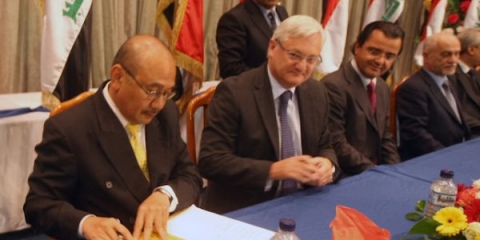
Iraq’s Cabinet approved an initial gas agreement between the Oil Ministry and Royal Dutch Shell to invest in a joint venture to tap natural gas in southern Iraq, a government statement said.
The agreement calls for establishing a joint venture between the state-run South Oil Co. and Shell to exploit the fields, the statement added without any other details.
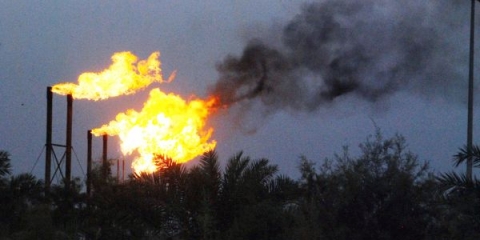
Shell is expected to invest US$3 billion to US$4 billion over five years to gather at least 500-600 million cubic feet of flared gas per day from the southern fields, the AP reported.
The state-run South Oil Co. is expected to control 51 percent of the venture, while Shell would hold the remaining 49 percent.
The agreement provides for construction of a number of liquefied natural gas facilities, the statement said.
Iraqi oil exports eased slightly in August due to lower shipments of Kirkuk crude from the country’s north, shipping data compiled by Reuters showed.
Exports averaged 1.83 million barrels per day (bpd), compared with 1.85 million bpd in July, according to Reuters. The total comprised 1.52 million bpd from the south and 310,000 bpd from the north.
Iraq has built up output this year due to more stable flows from the north, where sabotage and technical problems previously kept production all but idle, allowing Baghdad to earn more cash to fund reconstruction.
Exports of Kirkuk crude from the north declined because there were some interruptions in pumping along the pipeline to Turkey, shipping sources said.
Iraqi Oil Minister Hussein Shahristani called Japanese companies working in oil industry to participate in Iraq reconstruction, the ministry spokesman Issam Jihad said.
He also added that the Japanese cooperation with the Ministry in oil field is very wide, al-Sumaria reported.
Jihad also pointed out that Oil Minister, while receiving Japanese officials in Baghdad and a number of Japanese businessmen, called Japanese industries specialized in Oil Industry to enter the Iraqi market and to participate in reconstruction of Iraq economy.
He also added that Japanese societies uttered willingness to cooperate with Iraq Oil Ministry in different fields especially after the stabilization of the security situation in Iraq.
Iraqi oil policy has finally surfaced on the radar screens of local politics, five years after the US-led invasion. However, much confusion and misunderstanding still surrounds the exact process of how the industry would develop and what role would be retained for the proposed National Oil Company (NOC) and its affiliates, and how wide a door would be opened for International Oil Companies (IOCs).
While the Ministry of Oil has strived to retain a clear role for the federal authorities in drawing up an oil policy, it has faced persistent challenges from both the Kurdistan Regional Government (KRG) and from federal institutions in Iraq, including the cabinet, as well as private interests, who point to the fact that the KRG has been able to sign 22 contracts with the IOCs, while the federal Ministry of Oil has not signed a single development agreement so far, writes Walid Khadduri for Petroleumworld.
##


It is good not to waste the flared gas. It would be MUCH better if they re-injected the gas into the oil reservoir to increase the percentage of recovered oil. There is no gas cap in Rumaila so (generally) the gas dissolved in the oil is the drive. The gas being flared gas represents a significant portion of the reservoir energy required to move the oil through the reservoir rock to the wells and push it out to production facilities. The projects are not mutually exclusive as there would be dry (stripped) gas available in excess of available compression for re-injection and the project would have a longer life if much of the gas were stripped and “recycled”.
it ironic that southern iraqi company not given funds with the iraqi coffers full oil money to redevelop the fields existing or new creating much needed jobs in the area and beyond and resulting in iraq increased production of oil.
although technical know how and equipment can be purchased and foreign companies in the fields which are undiscovered the oil law is generating such problems for future generations when it is said the last drop of oil in world will come out of iraq.
Iraqi reserves r very high much than published and that is the reason the multi-national companies clamer over each other to get into iraq.
It such a state that crucial decisions should be left until there is a much more stable iraq, and when iraq can negotiate from a point of strength right now deals that can be done with iraq on its knees.