Plus:
*More details ahead of the roadshow
*Kurdish national MP says oil law moving
*KRG minister says natural gas to provide power for Kurds, industry and all of Iraq
*Barzani heads to Baghdad for talks soon
*Oil Search starts drilling
*Shahristani talks pipeline plans
*U.S. report warns of upcoming ethnic violence
*Turkey readies for incursion
*Sadrist MP killed
*The Iraq Press Roundup and more
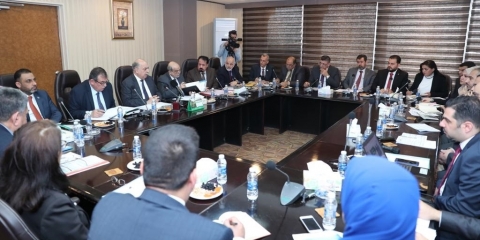
A delegation led by Iraq’s oil minister Hussain al-Shahristani will present prequalified companies at a meeting in London on Monday with geological data on the fields, as well as details on the financial terms of the contracts and the process for applying, Tom Bergin reports for Reuters. The contracts on offer are service contracts, which mean the winners will be paid a flat fee to produce the oil rather than receive an equity stake in the fields or any share of profits. Forty-one companies, including most of the big international oil companies, have qualified to bid.
A member of the Parliament and the Parliament Oil and Gas Committee announced that a draft law that both the Kurdistan Regional Government and the central government agreed upon will be submitted to Parliament for discussion and final approval, Aiyob Mawloodi reports for The Kurdish Globe. Bayazid Hassan, a Kurdish MP on the Kurdistan Alliance List, told a local Kurdish news agency that the Iraqi Minister of Oil, Hussein al-Shahristani, has promised to send a copy of the draft to Parliament.
The oil and gas chief of Iraqi Kurdistan says the region will develop its natural gas resources to provide electricity to its residents and a planned industrial center, and in the future “export to the rest of Iraq,”Ben Lando reports for United Press International. “The aim is to replicate some similar projects to make sure that in the end we will end shortages and hopefully export to the rest of Iraq,” KRG Minister of Natural Resources Ashti Hawrami told United Press International.
Iraqis both within and outside the Kurdistan Regional Government’s three northern provinces suffer steady shortfalls of electricity. Baghdad and the KRG have been at odds over the rights to sign oil and gas contracts in Iraqi Kurdistan. While the Dana-Crescent (Dana is partly owned by Crescent) deal is a service contract, the KRG has signed two dozen controversial production-sharing contracts with international oil firms exploring for and developing oil and gas, which the national oil minister has called illegal. The dispute has delayed passage of a new oil law and legislation governing revenue, the Oil Ministry and the state oil company said.
Kurdistan Region President Massoud Barzani will head a delegation to Baghdad in the coming days to meet with top Iraqi officials, said Iraqi President Jalal Talabani on Monday after a meeting with Barzani, The Kurdish Globe reports. “The meeting discussed the [Kurdistan] Region President’s visit to Baghdad for negotiations on finding solutions to the current problems,” said President Talabani at the conference. Main topics will be the oil issue, security conditions, and Iraq’s relations with its neighbors. A member of the KDP politburo, Mahmoud Muhammad, told the Globe that the suspended problems between Erbil and Baghdad are complicated and interrelated; thus, solving them is not an easy task.
Oil Search says it started drilling the Shakal-1 prospect, which is part of the production sharing contract it and partners Petoil have with the Kurdistan Regional Government. “No further releases will be made unless there is a material or share price sensitive outcome,” the company said in a statement.
Iraq’s pipeline plans include expanding the northern Kirkuk-Ceyhan oil pipeline, rework the pipeline to the Banias port on Syria’s Mediterranean coast and hook up to the Arab Gas Pipeline via Syria, Oil Minister Hussain al-Shahristani told an energy conference in Turkey, Platts reports.
Sharjah Ruler receives delegation from Iraqi Oil and Gas Parliamentary Committee, the UAE Daily News reports.
Iraq’s Ministry of Water resources Thursday announced it signed a number of agreements with International firms to erect dams in Kurdistan regions, Voices of Iraq reports.
A local company has wrapped up the first stage in a project to improve electricity energy efficiency in the southern Iraqi city of Basra, an official statement said. “The project has been referred by the reconstruction and services committee in Basra and will be financed through the $100 million grant allocated by the prime minister for the province,” according to a statement released by the Iraqi cabinet’s national center for media and received by Voices of Iraq.
A nearly completed high-level U.S. intelligence analysis warns that unresolved ethnic and sectarian tensions in Iraq could unleash a new wave of violence, potentially reversing the major security and political gains achieved over the last year, Jonathan S. Landay, Warren P. Strobel and Nancy A. Youssef report for McClatchy Newspapers.Sources of tension identified by the NIE, they said, include a struggle between Sunni Arabs, Kurds and Turkmen for control of the oil-rich northern city of Kirkuk; and the Shiite-led central government’s unfulfilled vows to hire former Sunni insurgents who joined Awakening groups.
Turkey’s parliament voted overwhelmingly on Wednesday to extend by one year its authorization of military operations against Kurdish separatists in northern Iraq, keeping the door open to future strikes in the region, Sabrina Tavernise reports for The New York Times. Turkey contends that Iraq does not do enough to curb the rebels, known as the Kurdistan Workers’ Party, or P.K.K., who hide in the mountains along its northern border. Iraq says far more reside in Turkey. The tension is a delicate matter for the United States, which counts Turkey and the Iraqi Kurds among its closest allies in a troubled region. When Turkey made a brief ground incursion early this year, the Bush administration pressed for a withdrawal. The Turkish strikes, however, have not ruined relations with Iraq, and even opened fresh lines of diplomacy between the countries.
Turkish Prime Minister Recep Tayyip Erdogan has threatened to launch a fresh incursion into northern Iraq as warplanes bombed Kurdish rebel targets across the border after a deadly attack killed 17 troops, Agence France-Presse reports.
A media advisor from the Kurdistan’s regional parliament on Wednesday said that the Iraqi government and the coalition forces will be “morally responsible” for any possible Turkish military incursion into the region’s territories, Voices of Iraq reports.
An Iraqi member of parliament has been killed in a roadside bomb attack in eastern Baghdad, officials say, AlJazeera reports. At least two other people were also killed in the attack on the convoy of Saleh al-Auqaeili, a member of the Sadrist bloc, on Thursday.
Iraqi parliament Speaker Mahmoud al-Mashhadani said in Tehran that the presence of foreign forces in the country is the biggest problem facing Iraq, while Iranian Majlis Speaker Ali Larijani reiterated his country’s support to Iraq, Voices of Iraq reports.
In recent years, as secular state authority has declined and religious parties have assumed greater control over the political process, Iraqi citizens have increasingly turned to religious fatwas as a source of guidance, Saleem al-Wazzan writes for Niqash. Sayyed al-Sistani’s 2005 fatwa calling on Iraqis to participate in elections demonstrated the power of clerical influence, especially within the political process. According to Saeed Khudair, a political researcher at Basra University, the level of clerical influence asserted in Iraq today is unprecedented.
A large number of employees from the State General Company for Textile Industries in Wassit staged a demonstration calling on the government to pay them their outstanding dues, Voices of Iraq reports.
Read what Iraqis read: the Iraq Press Roundup by UPI’s Alaa Majeed.
Iraqi lawmakers in Parliament Wednesday failed to reach a resolution in debates over minority representation in the provincial elections law, UPI reports. The Iraqi Parliament had scheduled debates Wednesday over Article 50 of the provincial elections law, which dealt with minority representation. Lawmakers passed the law in September with a quota set for female representation but excluded other minority religious groups.
The Association of Muslim Scholars in Iraq condemned leaflets distributed in the northern city of Mosul that threatened the Christian community there, UPI reports. The AMSI said in a statement on its Web site that the leaflets called on the Christian community to convert to Islam, pay a tax levied against non-Muslims, called jizya, or face death.
Federal regulators have launched an inquiry into whether broadcast networks and military analysts violated federal sponsorship identification rules as a result of an effort by the Pentagon to increase favorable news coverage of the Iraq war, Amy Schatz reports for the Wall Street Journal.
–


0 Responses to “Four days until Iraq oil and gas fields unveiled to international oil firms”
Leave a Reply