One oil field awarded, many questions remain

One oil field awarded, many questions remain

Iraq’s Oil Ministry must decide what next after putting eight oil and gas fields up for foreign oil investors.

Home » Politics

Maliki, oil and gas committee to meet on Iraq oil law

Submitted by Ben Lando on Monday, 27 October 20082 Comments

Draft version received in Parliament Sunday, kicked back to council of ministers for legal clarification

Plus:
*Japan envoy meets on Iraq oil
*Chinese team expected in November
*Industry Ministry workers demand pay promise
*Reaction to U.S. attack on Syria-Iraq border
*KBR accused of sticking U.S. taxpayers, shocking American workers in Iraq
*Fallujah sewage project at $100M, waste still in the streets
*Barzani back from Iran, en route to Washington
*Iraq in the Time of Cholera
*Much more

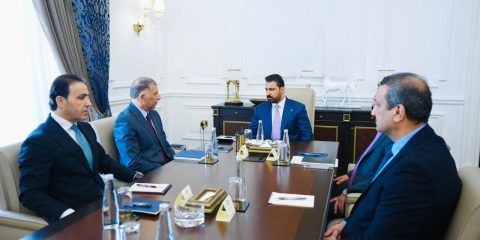
The Iraqi Parliament’s Oil and Gas Committee will meet Tuesday with Prime Minister Nouri al-Maliki to determine the fate of the draft oil law, after a version of the long-awaited bill made a brief appearance in Iraq’s Parliament Sunday before being kicked back to the Council of Ministers.

Ben Lando and Alaa Majeed of United Press International spoke to committee members who, despite differing opinions of what the final oil law should look like, all say they want the Council of Ministers to sign off on the legislation and give it to Parliament once and for all.

The law has been — and remains — stuck in a dispute between segments of Iraqi society over two key issues: to what extent companies other than the Iraqi state oil companies should be allowed to enter the oil and gas sector, and to what extent control over the oil strategy will be decentralized to the local governments (oil-producing provinces and regions).

Since negotiators struck a deal in February 2007, the committee has received four different versions, none of which has the full Council of Ministers’ approval, including the latest version.

Ali Belo, the chairman of the committee and member of the Kurdistan Alliance party, said he wants the Council of Ministers to approve the February draft or an updated version so the Parliament can begin debate. …

Abdul-Hadi al-Hasani, the deputy chairman of the committee and a member of Maliki’s Dawa Party, part of the Shiite-led coalition in government, said they told Mahmoud al-Mashhadani, Parliament speaker and member of the Sunni Iraqi Accord Front, they didn’t want a legal point-of-order argument to stall the bill before the legislators — and oil experts, campaigners, non-governmental organizations, media and citizens — got the chance to debate the law.

Hasani said the committee wanted the first reading this week but will now press Maliki and his Council of Ministers to “clarify the matter as quickly as possible.”

“It could take some time; it’s not really a quick law to be passed. It is the most important law in Iraq’s economy,” he said. …

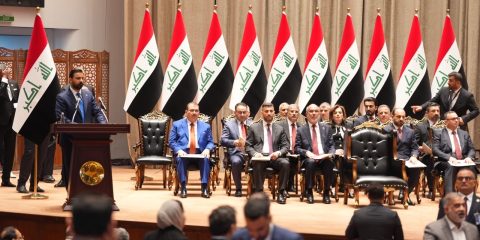
It’s not clear how the draft law can make it through Parliament at this time. The body is busy on key issues with upcoming provincial elections and the federal budget amid an oil price free fall. At the same time, the Status of Forces Agreement to keep U.S. forces in the country not only will dominate any legislative session but also has invigorated the nationalism that comes into play with a law as controversial as the oil law. By offering up a nationalized oil sector to the international oil companies — especially without a plan to rebuild the capacity of the once-leading Iraqi oil workers and the domestic industry capability — the law is viewed suspiciously.

Hasani said three related laws — revenue sharing, restructuring the Oil Ministry and reconstituting the Iraqi National Oil Co. — are no longer being considered as a package with the oil law.

“Everything is subject to discussion; there is no doubt about that,” Hasani said when asked if the version the Council of Ministers gives to Parliament could be altered in the democratic process.

Read the entire article: Click Here (free registration required).

Japan’s ambassador to Iraq has met with a key Parliamentarian on cooperation in oil and other sectors, Voices of Iraq reports.

China’s Energy Ministry is expected in Iraq next month to meet on developing the Ahdab oil field, Voices of Iraq reports. The field was granted to the China National Petroleum Corp. in the late 1990s as a production sharing contract but this month was renegotiated and resigned as a service contract.

The Qudas Generation Plant project will boost power generation by 200 megawatts by early 2009, according to Erich Langer of the U.S. Army Corps of Engineers.

Workers in Iraq’s Industry Ministry companies are demanding due pay after a protest in Basra, Voices of Iraq reports.

A U.S. attack on the Syrian side of the border with Iraq provoked reaction from Syria and Iran, which called it U.S. unilateral aggression in the region,Katherine Zoepf reports for The New York Times. “The United States is trying to negotiate a strategic agreement with Iraq that would allow American troops to remain in the country and carry out military operations. The pact faces strenuous opposition from neighboring countries, especially Syria and Iran, because of concerns that the United States might use Iraqi territory to carry out attacks on them. … Also Sunday, the chief of the Wasit provincial council announced that he had refused to sign a memorandum of understanding with United States forces that was intended to formalize Wasit’s transfer to the control of Iraq’s own security forces. Wasit, a province that borders Iran, was due this week to become the 13th of Iraq’s 18 provinces to be handed over to full Iraqi control. The council chief, Muhammad Hassan Jasem, said he had rejected the memorandum because its first article gave the United States permission to continue military operations in Wasit.”

The Pentagon’s contractor office claims KBR – the former Halliburton subsidiary – produced such poor work on the taxpayer’s dime that U.S. personnel were frequently shocked, among other allegations, James Risen reports for The New York Times. “The Defense Contract Management Agency, the Pentagon agency in charge of supervising contractors in Iraq, determined in August that KBR, the Houston-based company that provides virtually all basic services for the American military in both Iraq and Afghanistan, has been guilty of “serious contractual noncompliance” in Iraq, the officials said. … KBR, formerly a subsidiary of Halliburton, has had a virtual monopoly on military services contracts in Iraq since the 2003 invasion, garnering more than $24 billion from its business in the war zone. Questions about the quality of KBR’s electrical work on American bases in Iraq have plagued the company throughout 2008, leading to investigations and hearings by Congress as well as an inquiry by the Pentagon’s inspector general. Internal Pentagon documents obtained by The New York Times suggest that the electrical problems may be more widespread than had been believed. A chart compiled by Army officials and not previously made public shows that more American personnel have been electrocuted in Iraq than the Bush administration has acknowledged.”

A $100 million project to provide a livable sewer system to embattled Fallujah failed because of poor U.S. contracting and insecurity. (It also serves as necessary context when Iraq’s government is criticized for not spending more of its money on reconstruction projects.) Julian E. Barnes reports for the Los Angeles Times: “Sewage continues to run in the streets, and the Special Inspector General for Iraq Reconstruction found that the system may never be properly connected to individual homes, lacks the necessary fuel to operate and is unlikely to ever cover the full city. … Auditors found that in addition to the security problems it faced, the project was derailed after it was twice redesigned, costs skyrocketed and the U.S. government was paralyzed by “indecision” about what to do.

Once scheduled for completion in January 2006, the project, which had a budget of $32.5-million, now is supposed to be finished in April, while costs have shot up to $98 million.

It was originally to cover all 24,400 dwellings in Fallouja, but will serve only 9,300 houses, about 38% of the city, at a cost of more than $10,000 a home. But despite all the money allocated, no funds have been set aside to connect the homes to the sewer system. … The initial contractor, FluorAmec of Greenville, S.C., was removed from the project after a year. That company was replaced with a string of local contractors.

Flynn said it was amazing that as much work on the system got done — thanks, he said, largely to the Army Corps of Engineers.

But he added that the project is in danger. The sewer system needs between 4,800 and 6,000 gallons of fuel a day to run, but fuel is in short supply. If the system, if it becomes operational, were to shut down, sewage would back up into homes within a day.”

Days after meeting with Iranian leaders, the head of Iraq’s Kurdistan region is en route to Washington, D.C. Massoud Barzani, president of the KRG, is leading a delegation to Washington to meet with President Bush and others, Voices of Iraq reports. At the top of the agenda is surely the stalled status of forces agreement with the United States. Last week his nephew and the prime minster of the KRG, Nechirvan Barzani, told Deborah Haynes of The Times of London a year’s end deadline for the agreement will likely be missed but U.S. troops will remain in Iraq at some level for at least the next 12 years.

The magic of cinema fades, Ahmad al-Sa’dawi writes for Niqash. In forgotten days of peace cinema-going was long a favoured Iraqi pastime. Iraqis young and old relished a trip to the cinema and the industry flourished, gaining regional fame. Today, however, the tradition is in danger of fading away completely.

Iraqis are threatened not just by bullets and bombs, but by environmental catastrophe, Aseel Kami reports for Reuters. “Long after the shooting and bombing stops, Iraqis will still be dying from the war.

Destroyed factories have become untended hazardous waste sites, leaking poison into the water and the soil. Forests in the north and palm groves in the south have been obliterated to remove the enemy’s hiding places.

Rivers are salted, water is contaminated with sewage, and land is strewn with mines, unexploded bombs, chemical waste, rubble and trash.

‘When we talk about it, people may think we are overreacting. But in fact the environmental catastrophe that we inherited in Iraq is even worse than it sounds,’ Iraqi Environment Minister Nermeen Othman said in an interview.

‘War destroys countries’ environments, not just their people. War and its effects have led to changes in the social, economic and environmental fabric,’ she said. ‘It will take centuries to restore the natural environment of Iraq.’”

Fishing in Iraq, once a prominent lifeline, now entails evading Iranian and Kuwaiti harassment for the few fish stocks remaining, Raheem Salman reports for the Los Angeles Times. “Some days, fisherman Aoun Saleh loves life on the seas: the friendships, the jokes, the singing, especially when they have a big catch. But some days he rues the day he first walked onto the docks.

Like the time, he says, the Kuwaiti sailors stopped his boat in midwinter and forced the entire crew to swim in the cold waters. Or when the Iranian coast guard held him and other fishermen captive, forcing them to cook and clean for them. More recently, he said, Iranian sailors stopped his boat in Iraqi waters, stole the fish and threatened to take the Iraqis to Iran.”

Iraq in the Time of Cholera: With all the tragedies that the occupation brought to Iraq, the last thing it needs now is an epidemic, the cholera which is spreading in big numbers. , writes Sabah Ali.

2 Comments »

Leave your response!

Add your comment below, or trackback from your own site. You can also subscribe to these comments via RSS.

Be nice. Keep it clean. Stay on topic. No spam.

You can use these tags:
<a href="" title=""> <abbr title=""> <acronym title=""> <b> <blockquote cite=""> <cite> <code> <del datetime=""> <em> <i> <q cite=""> <strike> <strong>

This is a Gravatar-enabled weblog. To get your own globally-recognized-avatar, please register at Gravatar.