Iraqi oil and gas moves could violate U.S. sanctions on Iran

Energy dealings between Iraq and Iran would likely violate U.S. sanctions, and are drawing condemnation from American diplomats, concern from experts.
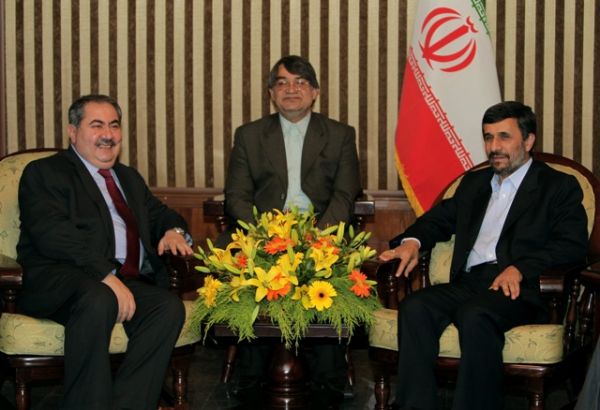
Iranian President Mahmoud Ahmadinejad (R) meets with Iraqi Foreign Minister Hoshyar Zebari (L) on the sidelines of the a two-day nuclear disarmament conference in Tehran on April 17, 2010. Iran slammed 'atomic criminal' the United States and called for its suspension from the UN nuclear body, urging changes at the UN Security Council and in the Non-proliferation Treaty. (BEHROUZ MEHRI/AFP/Getty Images)

Iraq would likely violate U.S. sanctions if it follows through with a series of proposed oil and gas projects with Iran, or if it continues to export fuel and oil via tanker truck – some of which is alleged to be smuggled.

President Obama earlier this month signed a law upgrading sanctions against Iran in response to Iran’s disputed nuclear program. Since the mid-1990s, U.S. policy has essentially presented companies with an ultimatum: if they choose to do business with Iran, then they risk losing access to American markets.

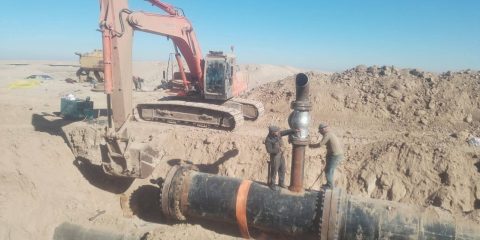
The Iraqi oil sector is brushing up against U.S. sanctions on Iran in three broad areas. First, the development of oilfields that straddle Iraq’s eastern border will likely cause both foreign contractors and Iraq’s state-run South Oil Company to negotiate profit-sharing or joint production deals with Iran. Second, two proposed pipeline deals would export Iraqi crude and import Iranian gas. Third, a steady stream of tanker trucks is currently exporting fuel and crude to Iran through Iraq’s northern Kurdish region.

The sanctions regime prohibits any foreign entity from investing more than $20 million in Iran’s energy sector, and bans any sales of gasoline or refinery-related services or equipment to Iran at a value of $1 million per shipment or more than $5 million over a 12-month period.

“We in the international community have a very serious issue with Iran and we’re going to need help from everybody on this,” U.S. Ambassador to Iraq Christopher Hill said in a recent interview. “Iraq needs to consider its own long-term interests as it proceeds.”

Iraq’s potential trouble with such sanctions is a result of normalizing relations with Iran, its enemy in the bloody eight-year border war of the 1980s. Many in the post-Saddam Hussein government in Baghdad have deep ties to Iran, and see their eastern neighbor as a natural partner in the development of Iraq’s massive oil and gas sector – including what could top $100 billion dollars in foreign investment.

Some surreptitious collaboration may already be underway. A report in The New York Times last weekend alleged that fuel and oil is being trucked into Iran from border crossings in Iraq’s semi-autonomous Kurdistan region – a scandal that not only renews a dispute between the central governments and the Kurds, but also could be the most active violation of the new U.S. sanctions.

“Virtually all of those activities would be potentially sanctionable under the Iran Sanctions Act, as amended by the new law that was just enacted last week,” said Kenneth Katzman, a specialist in Middle Eastern Affairs at the Congressional Research Service, which advises American legislators. “Pipelines to or from Iran, gasoline sales to Iran, et cetera, are all now sanctionable.”

Yet some intergovernmental cooperation is necessary if Iraq is to develop border oilfields without provoking violence. The Iran-Iraq war of the 1980s was sparked by border disputes and fueled by oil, and tensions have grown along the edge of Iraqi territory in recent years, most notably when Iranian forces occupied an Iraqi wellhead for several weeks last December.

Iraq has proposed three options for resolving disputes arising from border oilfields. First, the two countries could jointly develop the fields. Second, they could set an extraction quota and develop them unilaterally. Third, Iran could hire the same international company Iraq is using to develop the border field in question.

At least four of the oil fields Iraq awarded as development deals to international oil companies potentially cross into Iran, as well as one gas field being offered in a September auction.

The U.S. eyes cooperation between Iran and Iraq with suspicion. Ray Odierno, the commanding American general in Iraq, told reporters Tuesday that U.S. forces are bracing for attacks by Iranian or Iran-backed militias, and warned against Iranian influence in the ongoing formation of Iraq’s new government.

Indeed, some of the proposed cooperation between the countries seems more motivated by Iran’s geopolitical considerations than economic necessity, according to Samuel Ciszuk, Middle East energy analyst for HIS Global Insight.
Two proposed pipeline deals would bring Iranian natural gas to Iraq and send Iraqi crude to Iran – an arrangement without material benefit to Iran, which already produces more than enough crude for domestic use.

“When you build a pipeline, you have a long-term commitment,” Ciszuk said, noting that mutual dependence on billion-dollar infrastructure is a good way to cement an alliance. “The Iranians are politicizing their energy sector more and more.”

The pipeline deal could bring some benefit Iraq, which is in the midst of an electricity crisis. Imported Iranian gas would presumably help run the 25 new natural-gas power stations the Iraqi government plans to build – a supply the Electricity Ministry might welcome, in light of its long-standing complaints that the Oil Ministry has failed to provide adequate fuel for power facilities.

Those advantages aside, an energy alliance with Iran would potentially expose Iraq to U.S. sanctions, or at least great displeasure. The government of Iraq itself could not be punished under the current American policy, but any state-owned entity participating in the pipeline deals – such as the South Oil Company – could be a target.

In practice, sanctions often draw their power more from their tendency to deter investment than their ability to punish violators, according to Ciszuk of IHS Global Insight. The South Oil Company, for example, will have its hands full developing Iraq’s domestic oil sector and wouldn’t be hurt by sanctions barring it from U.S. markets – yet being marked with the stigma of sanctions could be enough to scare off important financiers.

“If they start dealing with Iran as they’re participating in upstream projects, then would Western banks say they don’t dare finance projects in which [Iraq’s] South Oil Company is involved?” Ciszuk said.

Since the Iran Sanctions Act was passed in 1996, several large oil companies, including Chevron and ExxonMobil, have divested from projects in Iran.

The Iraqi government has indicated its awareness of the sanctions issue, but hasn’t said what role such considerations are playing in its diplomacy with Iran or its oil-sector planning.

“So far there has been no agreement reached regarding to the joined development between Iraq-Iran and Iraq-Kuwait. It is too early to speak about this issue if it is not existed yet,” said Assem Jihad, spokesman for Iraq’s Oil Ministry. “The same with the gas [pipeline] coming from Iraq and the oil pipe going to Iran, which they are still not agreed yet – still too early to talk about them.”

When the issue reaches its flashpoint, the decision over whether to enforce such sanctions will lie with the U.S. president and the executive branch he directs.

The State Department’s Bureau of Economic, Energy, and Business Affairs, which is responsible for reviewing possible violations, has not indicated its position on the potential pipeline deals or the tanker truck exports through Kurdistan. A spokesperson for the bureau said that the pipeline was “still a hypothetical” and declined to comment further, while experts say it may be difficult to identify the actual sanctions violator in Kurdistan without dispatching a team to monitor the hillside border – a measure which seems unlikely.

In the 14-year history of the ISA, no sanctions have ever been imposed, and several companies have appeared to violate the policy without any consequences. Iran sanctions experts don’t expect the U.S. to break its precedent with Iraq.

“I very much doubt the Iraqi government or the KRG would be sanctioned, given that it is US policy to continue to help post-Saddam Iraq get on its feet,” said Katzman, of the Congressional Research Service.

Other sanctions besides the ISA have been imposed by the U.S. and the United Nations – with several more pending or under consideration – but those measures are designed to deter any foreign aid to Iran’s nuclear program. None of the new U.N. measures would likely affect the pipeline development, said IHS energy analyst Ciszuk, except by lending “moral support” to American pressure against Iran’s energy sector.

For now, the U.S. policy on the pipeline deals has not escalated beyond general displeasure, and such a diplomatic posture might be all that’s required. Like Iran, Iraq is a net importer of refined products, and arguably has greater economic interest investing its capital in building domestic refineries than in constructing bilateral pipelines. If the Americans can rattle their sabers loudly enough, it might convince Iraq that the costs of laying pipe with Iran outweigh the benefits.

“Clearly we have some very serious concerns about Iranian behavior,” said Ambassador Hill. “We have serious concerns about the level of influence from Iran.”

Ben Van Heuvelen reported from New York and Washington, D.C.. Ben Lando reported from Baghdad.

  • Print
  • RSS
  • -
  • +
  • Closed

0 Response to “Iraqi oil and gas moves could violate U.S. sanctions on Iran”


Comments are currently closed.