Northern exports stalled by Baghdad-Erbil disputes
With southern oil exports choked off by war, Baghdad cannot use its only backup pipeline route because of a fight with the KRG over customs revenue control.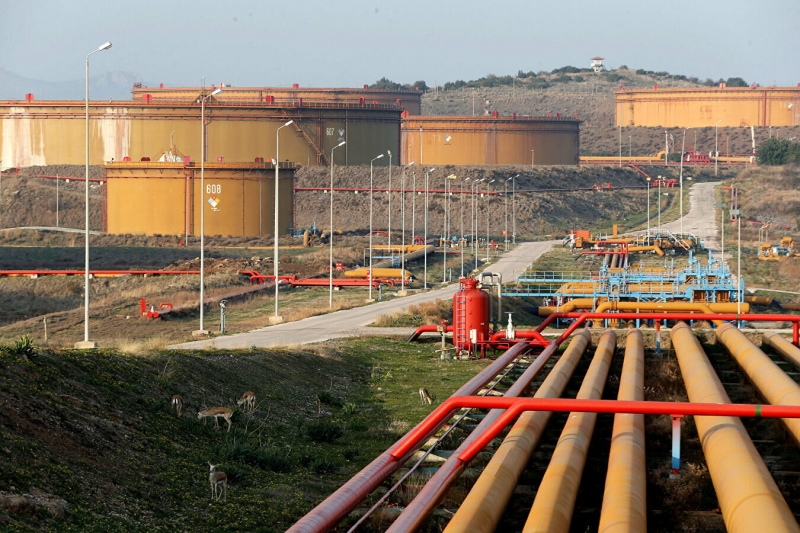
Iraq's only secondary pipeline export route remains almost entirely offline two weeks after the war in Iran began choking off oil flows from the Basra Gulf, depriving the country of its main revenue source and setting off a widening crisis for the energy sector.
Oil fields in Kirkuk are ready to send at least 150,000 barrels per day (bpd) through the northern pipeline system to Turkey, according to officials at the state-run North Oil Company (NOC), but there is a political delay centered on disagreements between the federal government and the Kurdistan Regional Government (KRG).
KRG leaders say they are unwilling to let NOC crude into the pipeline to Turkey unless Baghdad lifts a customs policy, imposed in January, that has caused a huge reduction in trade and decimated the regional government's revenues. One senior KRG official said Erbil is nearly insolvent as a result.
"This isn't just a customs dispute," the official said. "It's existential."
The stakes are high for Baghdad, too. The closure of the Strait of Hormuz has taken more than 3.2 million bpd of Iraq's southern exports offline, eliminating a revenue stream that averaged more than $6 billion per month in 2025, accounting for more than 90 percent of government funding. And the only remaining pipeline route runs through Kurdistan.
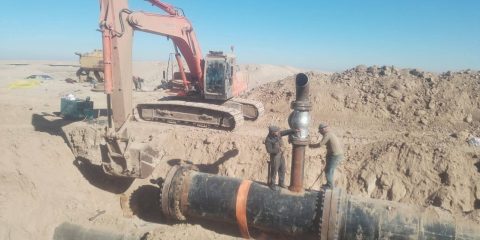
The Kurdistan Export Pipeline (KEP) has in the past carried crude from federally managed fields in Kirkuk up to the Turkish border, where there is a link into the Turkish side of the Iraq-Turkey Pipeline (ITP), which runs to the Mediterranean port of Ceyhan. Within the past decade, this network of pipelines has pumped as much as 650,000 bpd; before the Iran war, the pipeline was carrying about 200,000 bpd of KRG-produced crude but none from Kirkuk fields.
Multiple NOC officials said they have finished technical preparations to pump Kirkuk crude for export, and are only waiting on a political decision. According to multiple officials familiar with the talks, negotiators from Baghdad and Erbil met on Thursday but failed to reach an agreement for federal crude to flow through Kurdistan.
Revenue control
The core of the impasse is a fight over who controls customs revenue from Iraqi Kurdistan's ports and border crossings.
Under a long-standing status quo, the KRG has collected customs duties and remitted a share to Baghdad. The remaining revenue has been a primary source of funding for the regional government.
But now Baghdad is trying to implement a nationwide, UN-backed customs system known as ASYCUDA (Automated System for Customs Data). The new system aims to solve several old problems, including accounting gaps that have enabled money laundering and inconsistencies in tariff rates between border ports in Iraqi Kurdistan and federal Iraq. It would also place all revenue flows under Baghdad's control.
Under ASYCUDA, importers must register and prepay customs duties through a federal platform before they can access U.S. dollars at the Central Bank of Iraq's (CBI) official exchange rate to purchase foreign goods. Because KRG border crossings are not connected to the system, Kurdistan Region importers have been entirely cut off from this formal trade finance since Jan. 1.
The effect has been dramatic. Trade volumes have fallen steeply, multiple KRG officials said, and so have revenues.
Some importers have continued to bring in goods by purchasing dollars on informal markets at a premium, but that has come with other adverse side-effects: rising demand for dollars has pushed up their price, creating a widening gap between the CBI's official dollar-dinar exchange rate and the street rate, which hurts local purchasing power and creates incentives for the kinds of money laundering that ASYCUDA was meant to remedy.
The KRG has indicated willingness to compromise on some aspects of the dispute. In a recent letter to Sudani, which was seen by Iraq Oil Report, KRG Prime Minister Masrour Barzani proposes for the KRG to adopt the same tariffs as the federal government and administer its own ASYCUDA system, sharing the data in real time with the federal government. Such a setup would appear to address the transparency and anti-money-laundering goals of ASYCUDA, while enabling the KRG to keep control of revenue flows.
As a temporary measure — in the months it would take for the KRG to set up its own ASYCUDA — Barzani proposes "an interim arrangement for foreign currency transfers until ASYCUDA is fully operational. This would include appointing an independent external auditor to verify that tariffs are correctly applied to imports entering through the Kurdistan Region and that foreign currency transfers are reconciled with goods cleared through our border crossings."
That interim arrangement is ready to activate, according to the senior KRG official. All that is needed is for the CBI to issue a memorandum to banks authorizing trade financing under the KRG's temporary system.
A senior CBI official confirmed the proposal is workable in principle. "Technically it is possible, as a temporary emergency measure," the official said. "But it is more practical to have one system for the whole of Iraq."
The senior KRG official was blunt about why that temporary solution has not been approved: "The only objection in Baghdad is about political control."
Pipeline exports
The KRG is ready to give access to the northern pipeline system as soon as Baghdad approves the interim arrangement for CBI dollar access, according to multiple officials familiar with the talks.
The resulting exports are likely to be worth far more to Baghdad than its share of KRG customs revenue: at current prices, 150,000 bpd of Kirkuk exports would earn the federal government roughly $450 million per month, whereas the KRG has been remitting about $85 million per month in customs revenue.
While that would represent only a fraction of Iraq's usual oil revenues, it would provide useful liquidity at a time when the government could soon be forced to borrow against its foreign currency reserves to pay salaries and meet operating expenses.
Baghdad for its part appears to be reluctant to strike even a temporary deal during a period of relative weakness, and senior Iraqi officials say they are not bracing for a fiscal crisis.
"We are not assuming the conflict will continue for months or years," said one advisor to Sudani.
Beyond the customs issue, KRG leaders are also pressing Baghdad for help in improving energy sector security.
About 200,000 bpd of the region's oil production has been taken offline due to threats posed by Iran and Iran-backed armed groups in Iraq, highlighted by a March 5 drone attack on the Sarsang oil block and back-to-back attacks on the Lanaz refinery on Friday and Saturday. As a result, exports through the northern pipeline have slowed to a relative trickle.
The KRG does not appear to be demanding any specific new security measures as a precondition for federal crude to transit the northern pipeline system, but the senior KRG official noted that Baghdad has a significant interest in providing the kind of protection that would unlock more production from Kurdistan's oil fields: under the current export framework, revenues from KRG-managed crude pumped to Ceyhan flow directly to the federal government.
Ben Van Heuvelen reported from the United States. Mohammed Hussein reported from Sulaimaniya. Rawaz Tahir reported from Erbil. Iraqi staff reporting from Baghdad and Nassiriya are anonymous for their security.