BAGHDAD - Weeks after taking office, acting Electricity Minister Hussain al-Shahristani over the weekend ordered all union organizing be banned from ministry facilities, and rounded up documents and computers in Basra.
The move has been condemned by Iraqi unions and American and international labor groups as carrying on Saddam Hussein’s legal oppression of Iraqi workers’ rights.
Shahristani, who also holds the office of oil minister where he has fought oil-field workers in like fashion, issued his directives after the inspector general declared illegal any union organizing on ministry property. The inspector general in a statement warned against workers using threats of violence and sabotage, which the government will consider equal to terrorism.
Shahristani said he was just implementing a law as handed to him by the cabinet’s secretary general.
“It is not a new thing and when I went to electricity ministry I activated this law as I am very keen to implement the law,” he said. “When I found this law was inactive, I implemented this law, but the implementation of this law does not mean to accuse these unions that they belong to political groups or corruption.”
Shahristani added: “Any employee who gets a salary to do a specific work, is not allowed to do any other activities under any name, whether it is a union or humanitarian or a national activities or whatever activity is called.”
Workers in the public sector have been banned for decades from forming independent unions. While the U.S.’s Coalition Provisional Authority and subsequent Iraqi governments overturned many Baathist-era diktats, the anti-union law remained.
During Saddam Hussein’s time in power, unions were worker groups organized by and under the auspices of the state itself. Remnants of this are seen in the union offices and equipment that had been provided still by the ministry.
The cushy arrangement ended abruptly over the weekend.
The president of the Basra-based Iraqi Electrical Utility Workers Union, Hashmeya Muhsin Hussein, said workers “were stunned this morning to see police forces raiding our union and confiscate all private files and documentations and emptying the contents of the office.”
“We are decrying and condemning such decisions made against us and we shall carry on our struggle through all peaceful means like protests and strikes,” she said.
The inspector general, Alaa Mohie el-Deen, who until recently was in the same position in the oil ministry, in a statement echoed Shahristani, and added: “The ministry of electricity took an initiative to ban all forms of unionists’ activities that violate the laws and by issuing its orders to directorates and departments to send those whom resort to the use of force or the act of violence and those dissipating public funds to related judiciary entities to take the right punitive measures against them.”
He added that workers should “desist from such illegal activities and to abide with valid regulations and instructions to avoid being legally accountable,” going on to urge potential unionists to “head to legally registered civic society organizations for the best of public interests.”
Ra’ad al-Haris, a deputy minister of electricity, said unions should conduct union business from an independent location. He said unions were demanding offices and supplies, including phones and vehicles, which prompted the crackdown.
“At some sites they were closed by force,” he added.
“We’ve seen and heard reports of this. We’re looking into it,” said a spokesman at the U.S. embassy. “We hope that everybody resolves their differences in an amicable way.”
There are at least four different unions representing workers in the country’s electricity sector, which is all state-run.
The 2005 Constitution calls for a new labor law that adheres to modern international labor rights standards, but has not yet been approved by Parliament. The U.S. State Department includes Iraq’s workers’ rights in its annual critique of the country’s human rights record, though it has not formally pushed the Iraqi government outside of reminding it of its obligation as a member of the UN’s International Labor Organization, sources in Baghdad and Washington, D.C., said.
“If the Iraqi state is genuinely trying to embrace democracy, respect for the constitution and rule of the law it should adhere to international standards,” Sharan Burrow, president of the International Trade Union Confederation, wrote in a letter to Iraqi Prime Minister Nouri al-Maliki after the power sector crackdown began.
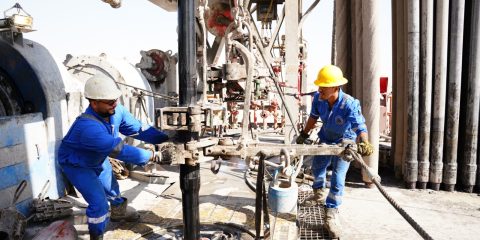
Unions in the powerful oil sector have also had their run-ins with the post-Hussein government. They quickly formed after the 2003 invasion and successfully prevented a U.S. contractor from taking over the refinery in Basra. Over the years they protested everything from government renege on pay and property to a draft oil law viewed as too gracious to foreign oil companies.
Earlier this year two leading oil union leaders were charged with stopping oil developments, which they deny. In April, five leaders in a refinery protest were moved from Basra to another state company in Baghdad.
Falah Alwan, president of the Federation of Workers’ Councils and Unions in Iraq, called accusations against workers “excuses to oppress the unions.”
“This move is a continuing campaign against the unions, unionists and workers by using threats to terrify them. It is a move which undermines the democracy in the country, if there some left,” he said.
Iraqi reporters contributing from Baghdad and Basra are anonymous for their security.


0 Response to “Shahristani clamps down on electricity unions”