BAGHDAD - Increasing any country’s production capacity from 2.5 million barrels per day (bpd) to 12.5 million bpd is a monumental task – and international oil companies are concerned that Iraq’s bureaucracy isn’t up to the challenge.
At a two-day symposium on Iraq’s oil expansion, BP and Shell presented papers on behalf of 16 oil companies that recently signed 11 massive development contracts, outlining current and future roadblocks put in their way by Iraq’s government. Iraq’s top oil contract negotiator, Abdul Mahdi al-Ameedi, said that session was the most important of the conference.
The companies expressed myriad concerns – from inadequate infrastructure and security, to byzantine visa and customs procedures. The common theme among their complaints was a lack of clear communication and coordination among the many government entities tasked with various aspects of the oil expansion.
Iraq’s ambitious seven-year plan to quintuple its production capacity is the biggest oil expansion ever attempted and not every project would make it, said a top executive from a major international oil company (who, like most of his colleagues, didn’t want to be quoted). Even with the influx of billions of dollars’ worth of foreign capital, such an increase will require quick and concerted collaboration between the ministries of Oil, Energy, Interior, Foreign Affairs, Transportation, Defense, Environment and Water.
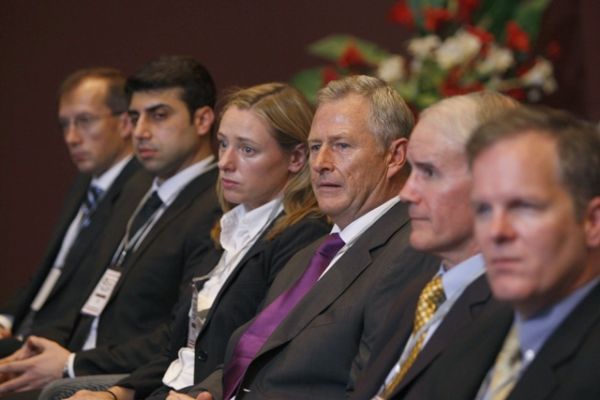
The symposium, held on Sunday and Monday at the Ministry of Oil in Baghdad, was an initial attempt to coordinate planning and problem-solving among companies and government ministries. In the sessions, according to the published agenda and accounts from those who attended, companies gave updates on their oilfield rehabilitation plans, the Oil Ministry explained oil and gas evacuation plans, and a handful of the ministries addressed their roles in other projects associated with the oil sector.
Iraq’s security problems and political volatility are also, of course, constant concerns. As the first day of the symposium began, elsewhere in Baghdad, more than 40 members of Sahwa – a Sunni militia allied with the government, often composed of former insurgents – were killed by a suicide bomber as they were picking up their paychecks. And more than four months after the national election, a coalition government has yet to be formed, with no resolution in sight.
“We have enough force to protect these companies,” said Maj. Gen. Hamid Abdullah Ibrahim, the head of the Iraqi Oil Police. “But they will still have these concerns until they start the work in the field.”
In an informal survey of participants, company officials seemed split in their response to the symposium between forward-looking optimism and pragmatic concern.
“It’s a positive step,” said an official from Halliburton, one of the more upbeat of the players.
“There’s no sense that there will be a follow up, a solution,” said another official.
Identifying the problems
“We should all communicate in order to know and to work together in order to move past the difficulties,” Shahristani said in his keynote speech.
The symposium succeeded, at the very least, in highlighting the major problems that the companies and ministries face.
One persistent complaint has been the hit-or-miss ability to obtain visas. Some companies, like Halliburton, said they’ve succeeded at getting the ministries of Oil and Interior to coordinate. Others say it’s still a logistical burden to get an executive into the country, let alone the hundreds of foreign workers who will need to come when the field development ramps up.
Many of the companies have yet to establish local offices, unable to navigate the mazes within the ministries of Trade and Interior – sometimes refilling applications lost in the process.
Sabah al-Saraf, the head of ports, told the symposium that the Transportation Ministry is focused on expanding the Umm Qasr port, which has been undergoing renovations in part with U.S.-funded projects. But British officials have said the port doesn’t have enough security to keep safe the millions of dollars in equipment that would need to be held there, and isn’t big enough to handle the influx of imported oil-well development parts.
“We are working in order to make all what can we do to make the task of the companies ease in developing the oil fields for the interests of our country and the companies.” Saraf said. “It is a mutual cooperation.”
Oil companies also complained that the customs procedure is inconsistent – sometimes tariffs must be paid, other times not..
The symposium drew criticism from some companies for not giving the Defense Ministry enough attention, since oil companies will have to work with that ministry to clear the millions of landmines and unexploded ordnance on the oilfields, left from previous wars.
By the time production starts, the government and companies will need to have found a solution to the degraded or under-capacity storage facilities, pipelines and gas-handling infrastructure. On top of those infrastructure challenges, companies also face a limited supply of water – an essential ingredient in boosting oilfield pressure and production.
Finally, the traditionally messy business of oil in Iraq will have to abide by expected new environmental regulations.
“Was it all solved within the last two days? No. Was it noted? Yes,” said an optimistic Michael Townshend, Iraq President for BP.
“As a result of the meetings I started to hear discussions from other ministries about ‘this is what we’re going to do and this is how we’re going to do it,’ and invitations for people to come talk to them,” said James Adams, Vice President of Exxon Mobil. “I’m not as pessimistic as some of the others.”
Transparency struggles
Iraq has touted its development of the oil sector as a model of transparency, yet the symposium was mostly opaque to the general public. Despite invitations from the ministry’s press office to attend the symposium, journalists were barred from all but the opening speeches by Oil Minister Hussain al-Shahristani and Thamir Ghadhban, the top energy advisor to the government. According to sources inside the hall, there was nothing confidential being discussed.
By contrast, the two oil and gas auctions last year were held in public ceremonies at the ministry’s auditorium and broadcast on live TV while dozens of journalists noted the price each company offered for the 18 projects. Eventually, 11 deals were signed and the ministry has been talking to the media to publicize information about the contracts.
“The most important is for the media to be there because then it lets people outside who cannot attend the symposium know what’s going on…especially the service companies,” said one major oil company official.
The Oil Ministry said it was the international oil companies who wanted the symposium closed press, But officials of a number of the companies said they were warned ahead of time that the event would be public, and had tuned their presentations accordingly.
The content of those presentations consisted of constructive criticisms of the government. By keeping such commentary behind closed doors and out of the headlines, the Oil Ministry effectively decreases the pressure on the government to reform. It also highlights another challenge for the government: to prepare for the media attention that comes with its ambition to be the world’s largest oil player.
Work already ramping up
The contracts from last year’s auctions have all been signed, and the capital investments for each project will range from $2 billion to well over $15 billion, according to early estimates by companies – a number surely to be revised upward. Development plans are under way.
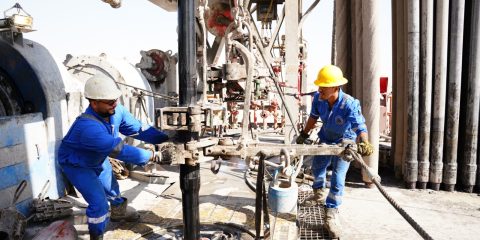
All companies have either let contracts for well drilling and workovers, or are readying to bring in seismic crews to see exactly how much oil is there to be extracted.
Each contract requires companies to spend $5 million per year on training Iraqi workers, which will lead to a new class of geologists, pipefitters and other oilfield crew jobs. After three decades of war and sanctions, Iraq currently lacks young, homegrown oil-industry specialists to replace the older generation that is approaching retirement.
Many of the fields are in rural and poor parts of the country. The companies are preparing to invest in roads, hospitals, schools and other developments being coordinated by local elected officials and tribal leaders.
The overarching development goal is “to avoid relying on (revenue from) natural resources and substitute it with foreign direct investment,” said Ghadhban, the government’s energy advisor.
Rather than fund such projects with oil money, Iraq’s strategy calls for oil companies to execute such development themselves as a part of their production deals. Community investment will be what local officials use as the “yardstick for measuring the contracts awarded,” Ghadban said.
Iraqi staff contributing from Baghdad are anonymous for their security.


0 Response to “IOCs and ministries air concerns in long haul to 12.5 M bpd”